OTP verification has quietly become the backbone of India’s digital economy. Every time a customer logs into their banking app, confirms a payment, signs up for a new account, or resets a password — an OTP is running behind the scenes, silently deciding whether the experience feels seamless or frustrating.
In 2026, the volume of OTP requests in India is at an all-time high. With UPI crossing 12+ billion monthly transactions, fintech onboarding exploding, and eCommerce becoming India’s preferred shopping method, OTPs are being generated at a scale no one predicted a few years ago. Yet customers only see one thing: “Did my OTP arrive on time?”
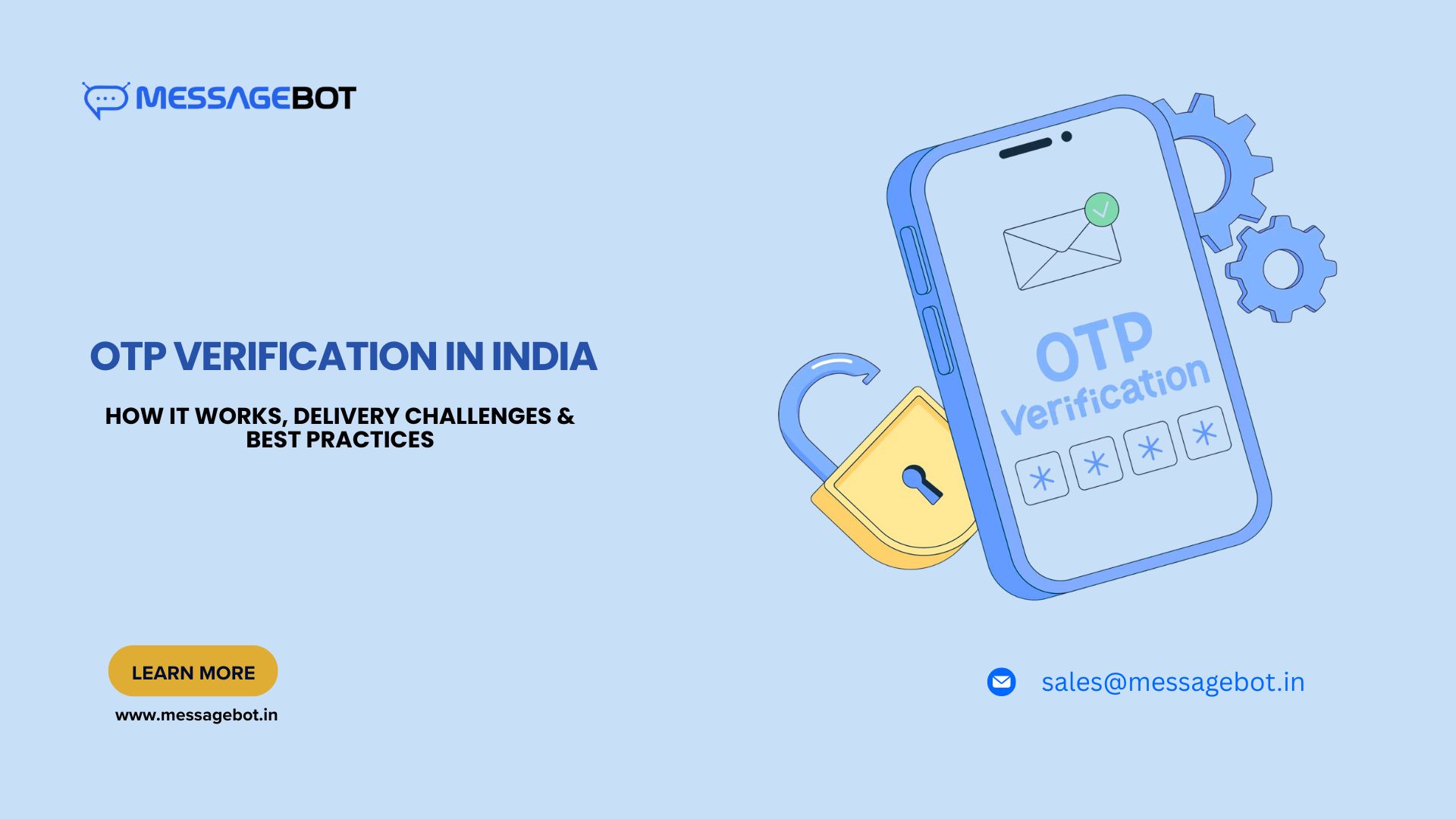 For businesses, this question is becoming a turning point. OTP delays don’t just create inconvenience — they break trust, interrupt revenue, and weaken the very foundation of user security. That’s why understanding OTP verification India today means going far beyond “send an SMS” and into the deeper layers of routing logic, DLT systems, authentication flows, telecom constraints, and customer expectations.
This guide breaks down OTP verification in India with a lens on reliability, compliance, user experience, and the realities of 2026.
What Is OTP Verification?
A One-Time Password is more than a numeric code — it’s a handshake of trust between a brand and its customer. In India, this handshake carries more weight because of the scale, diversity of devices, language differences, and massive dependence on mobile-first services.
Customers expect OTPs to be:
- Instant
- Accurate
- Secure
- Delivered through their preferred channel
(SMS, WhatsApp, Voice call, or Missed call)
And businesses must deliver all of this while navigating one of the world’s most complex telecom compliance environments.
While SMS OTP remains the default for most companies, WhatsApp OTP, Voice OTP, and Missed Call Verification are rapidly becoming part of multi-layered identity workflows — not replacements, but reinforcements.
How OTP Verification Works
On the surface, OTP looks simple. A box appears, you click “Send OTP,” and a code shows up. Behind that moment, however, a series of tightly sequenced systems snap into action.
Let’s break down a modern OTP verification India workflow the way engineers and product owners see it:
Step 1: A trigger from the user
Login → “Send OTP”
Signup → “Verify your number”
Payment → “Enter the OTP received”
This event starts the authentication workflow in your backend.
Step 2: OTP generation
A backend system creates a time-bound code — usually 4 to 8 digits.
It must be:
- Random
- Expiring within 30–90 seconds
- Stored securely in cache (Redis, not database)
Step 3: Sending the OTP
This is where complexity explodes.
Businesses can choose any channel:
- SMS OTP
- WhatsApp OTP
- Voice OTP (IVR call)
- Missed Call OTP
Each channel has its own path, rules, and failure points.
SMS must navigate:
- DLT scrubbing
- Route selection
- Operator queues
- Device filtering
WhatsApp must pass:
- Approved templates
- Meta rules
- Internet availability
Voice OTP must overcome:
- Call drops
- Network issues
- User busy tones
Step 4: User enters OTP
Now your system must:
- Check accuracy
- Verify expiry
- Match session/device
- Detect suspicious behavior
- Allow limited retry attempts
Step 5: Success or failure
A successful OTP completes the journey.
A failed OTP, however, introduces friction — leading to timeouts, drop-offs, or worse, customer frustration.
Why OTP Delivery Fails in India (The Unfiltered Truth)
If you ask users why their OTP didn’t arrive, they’ll blame:
“Network”
If you ask businesses, they’ll blame:
“Operator delay.”
But the truth is more nuanced. OTP failures in 2026 stem from multiple layers — compliance, routing, devices, user behavior, and telecom constraints. Understanding these is crucial for anyone building a reliable verification flow.
1. DLT Template Violations — The Silent OTP Killer
Since TRAI introduced DLT, every SMS must match its registered template exactly.
A single misplaced space, missing variable, or altered format can lead to:
- Instant rejection
- Zero delivery
- No error message to the user
This is the most frequent cause of OTP delivery breakdowns today.
Want a refresher? See: DLT Registration in India
2. Grey Routes — Cheaper but Dangerous
Some providers still use grey routes — low-cost, unreliable paths that skip regulatory checks.
These routes cause:
- Random OTP drop-offs
- Fake “delivered” DLRs
- Slow message queues
- Higher fraud risk
We broke this down in detail in:
Direct vs Grey Route SMS: A Smart Guide to Real DLR Metrics
3. Operator Congestion — India’s Festival Problem
During festive sales, high-volume campaigns, or peak hours, operators throttle message flows to maintain network stability.
For businesses, this means:
- OTP latency jumps from 3 seconds → 20+ seconds
- Some OTPs fail entirely
- Delivery order becomes inconsistent
4. Device-Level Filtering — OEM Spam Blocks
Certain Android brands aggressively filter “unknown sender” SMS to reduce spam. OTPs often get caught unintentionally.
Brands most affected:
- Xiaomi
- Oppo
- Vivo
This problem is bigger in tier-2/3 cities.
5. Number Portability Issues
When a user switches:
- Jio to Airtel
- Airtel to Vi
- Vi to Jio
OTP routing sometimes breaks for 24–72 hours because each operator treats ported numbers differently.
6. Integration Mistakes at the App Level
Common errors include:
- Wrong sender ID
- Wrong DLT template ID
- Incorrect route configuration
- Missing callback URLs
- Invalid JSON payloads
If you need clarity on SMS API setup, check:
Bulk SMS API Integration in India
SMS OTP vs WhatsApp OTP vs Voice OTP vs Missed Call Verification
In 2026, no serious Indian business uses a single-channel OTP strategy. Customer behavior is diverse, network conditions unpredictable, and compliance rules constantly evolving.
Here’s a narrative-style breakdown of each OTP channel:
SMS OTP: Still the Default, but Not Perfect
SMS OTP has the advantage of universality — it works on every phone, in every region, without internet.
But DLT, grey routes, and congestion have made it less predictable than before.
SMS OTP is ideal when:
- Users are in low-internet zones
- The number is new (WhatsApp not activated yet)
- Compliance requires it (banking, govt apps)
We recently covered this in detail in our breakdown of the Best OTP SMS Providers in India — an important read if you’re evaluating providers or facing inconsistent OTP delivery.
WhatsApp OTP: The Fastest-Growing Verification Channel
For urban India, WhatsApp OTP delivers unmatched reliability and speed.
Users check WhatsApp far more than SMS — and notifications appear instantly, even if SMS inbox is full or blocked.
WhatsApp OTP shines when:
- You want higher delivery rates
- Users prefer app-based messaging
- You need rich interactivity
Voice OTP: When Nothing Else Works
Voice OTP cuts through SMS failures, DLT mismatches, and device filters because it uses a phone call instead of text.
Voice OTP is essential for:
- Rural regions
- Low-connectivity areas
- High-value transactions
- Elderly users who prefer calls
See: Voice OTP Service in India
Missed Call OTP: The Frictionless Alternative
A missed call verification flow is perfect when:
- OTP SMS is failing
- User wants a free, zero-input method
- App onboarding requires minimal friction
It’s cost-effective and surprisingly reliable.
Read: Missed Call Verification in India
Best Practices to Improve OTP Delivery Rates
To make OTP verification India truly reliable, businesses need a strategy that blends technology, smart routing, and user behavior insights.
Here’s the refined 2026 OTP success playbook:
1. Use Tier-1 Direct Routes Only
This guarantees:
- Lower latency
- True operator DLR
- No hidden hops
2. Validate DLT Templates Before Sending
Tiny deviations leads instant failure.
Your OTP provider should flag mismatches automatically.
3. Implement Multi-Channel Fallback
India’s top fintechs now use:
- SMS to WhatsApp to Voice to Missed Call
This single change can reduce OTP drop-offs by 60–70%.
4. Monitor OTP Latency (Not Just Delivery Rates)
Many providers claim 98% delivery — but OTP is time-sensitive. A delivered OTP after 40 seconds is still a failure.
MessageBot provides real-time latency monitoring, which is far more valuable than generic DLR percentages.
5. Use Smart Retry Logic
If SMS delivery lags for more than 5 seconds, retry on another operator route or switch channels.
6. Cache OTPs, Don’t Store Plain-text
Redis or Memcached is ideal for fast verification without database bottlenecks.
7. Rate-Limit OTP Requests to Avoid Abuse
Protects your service from:
- Bots
- Brute force
- Spam
- Cost wastage
The Future of OTP Verification in India
The OTP ecosystem is shifting from single-channel SMS to adaptive identity workflows.
Businesses increasingly design verification flows around:
- Context
- Device history
- Location
- Risk score
- User behavior
In future, India will see:
- More WhatsApp-first verification
- More Voice OTP in remote zones
- AI-driven risk-based OTP decisions
- Reduced dependence on SMS-only systems
- Stronger regulations and template policing
The brands who adapt early will see the lowest verification failure rates.
Choosing the Right OTP Service Provider
A dependable OTP provider in India must offer more than just SMS routes.
Evaluate using this checklist:
- Tier-1 routing
- WhatsApp + Voice fallback
- DLT automation
- Accurate latency stats
- Real developer documentation
- Indian support team
- Fraud prevention
- SLAs for OTP delivery
Providers who only send SMS are outdated for 2026.
Final Thoughts
OTP verification is the invisible infrastructure that holds India’s digital economy together. But delivering OTPs reliably in 2026 requires understanding compliance, routing, real user behavior, and India’s unique telecom landscape.
Businesses that rely solely on SMS are seeing rising failure rates. The future is multi-channel, intelligent, adaptive authentication.
With the right approach — and the right provider — your OTP success rates can hit 99%+ consistently.
Start Sending Reliable OTPs with MessageBot