
When an SMS provider promises "99% delivery rates worldwide," that number is almost never what it claims to be. The question you should be asking isn't what their delivery rate is — it's what their delivery receipts actually measure.
In India, where businesses depend on SMS for OTP verification, transaction alerts, and time-sensitive notifications, the difference between a direct route and a grey route isn't a technical detail. It's the difference between an OTP arriving in 3 seconds and a customer abandoning a payment flow because their verification code never came.
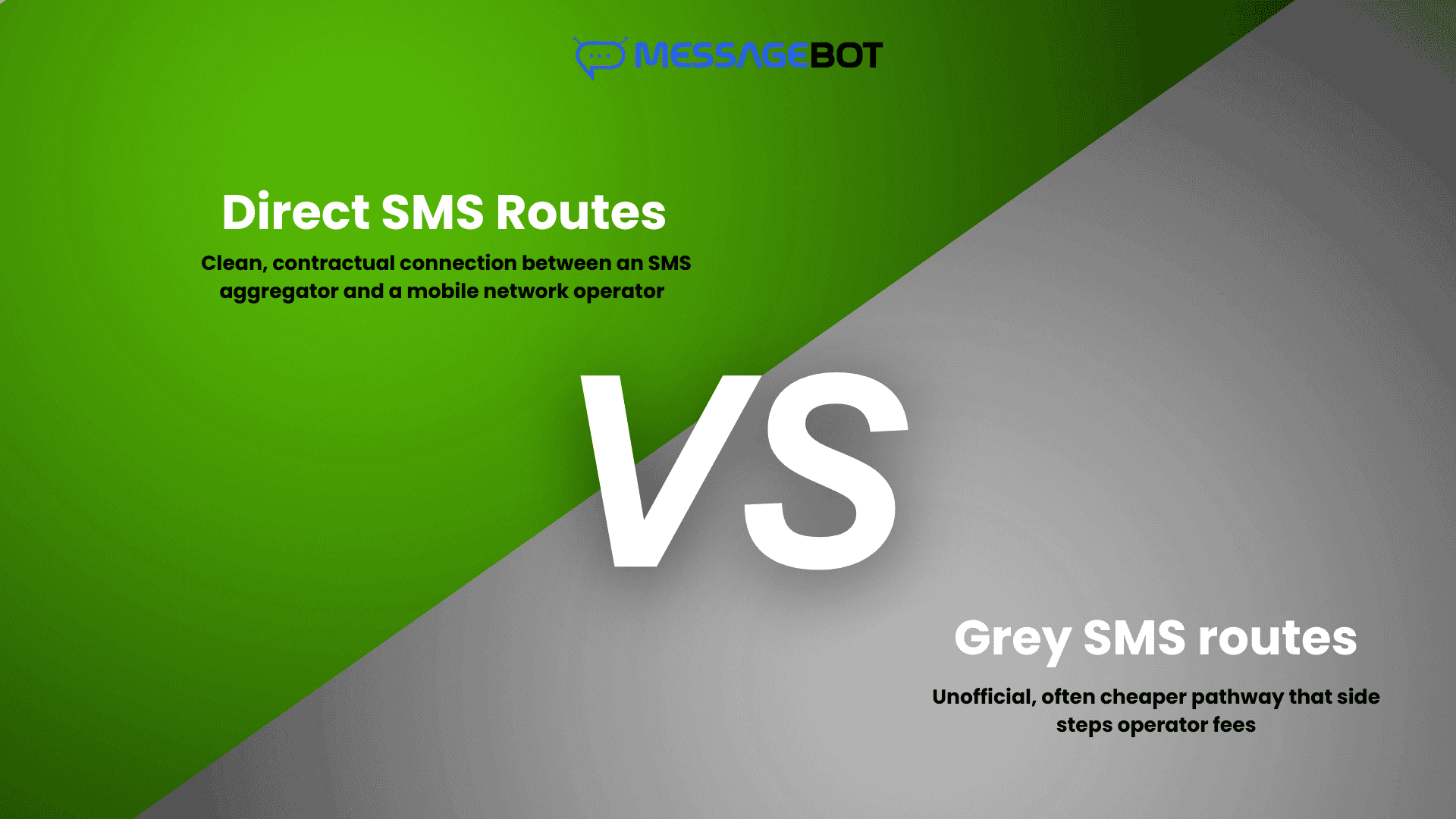
This guide explains what direct and grey routes actually are, how fake delivery receipts work, and how to audit a supplier's claims with math rather than trust.
What Is a Direct SMS Route?
A direct route is a formal, contractual connection between an SMS provider and a mobile network operator. The provider pays the operator's official interconnect fee, messages are validated through the operator's SMSC, and delivery receipts come directly from the operator's network — confirming actual handset delivery.
What you get with direct routes:
Operator authorization — traffic is legitimate and recognized
Stable, predictable delivery — no random failures from route availability
Operator-side DLRs — receipts reflect what actually happened at the device
DLT compliance — in India, direct routes handle TRAI's template validation correctly
Higher per-message cost — operators charge commercial interconnect rates
Think of it like buying electricity from the grid. You pay the utility company's rate, and power flows reliably. The infrastructure is maintained, the connection is legitimate, and when something fails, there's a real support path.
What Is a Grey Route?
A grey route is an unofficial path that bypasses or exploits telecom operator networks. Providers using grey routes take advantage of loopholes — SIM farms, foreign roaming agreements, manipulated SS7 signalling — to deliver messages at below-market cost without operator authorization.
What grey routes look like in practice:
No operator agreement — traffic is unauthorized or misrepresented
Unreliable delivery — messages may go through or fail silently with no pattern
Fake DLRs — providers often return "DELIVRD" status regardless of actual delivery
Pricing well below market — if an operator charges ₹0.15/SMS and a provider quotes ₹0.03, that's the signal
The same electricity analogy reversed: grey routes are like plugging into a neighbour's line illegally. Cheaper, but supply cuts off unpredictably, and eventually there are consequences.
Why This Matters More in India Than Most Markets
India's SMS infrastructure has specific characteristics that make grey route exposure worse than in other markets.
DLT compliance creates a hard filter. Since TRAI mandated DLT registration, every commercial SMS must carry a registered entity ID, sender ID, and template. Grey route traffic frequently fails this validation because the route doesn't have the operator relationships needed to pass DLT checks. Messages fail silently — the provider's system shows "submitted," the operator rejects them, and your DLR shows delivered. Understanding how DLT registration works in India makes clear why routes without direct operator relationships can't reliably handle DLT-validated traffic.
OTP delivery has zero tolerance for failure. A delayed promotional message is acceptable. A delayed OTP during a payment confirmation is an abandoned transaction. The most common causes of OTP delivery failure in India include grey route routing — where messages enter the network through unauthorized paths that operators deprioritize or block during congestion.
Fake DLRs make grey route problems invisible. When grey route providers manipulate delivery receipts, your dashboard shows healthy delivery rates while users complain about missing OTPs. What SMS DLR status codes actually mean — and how to distinguish operator-side receipts from aggregator-side receipts — is essential reading before you evaluate any provider's delivery claims.
The Math of Real SMS Delivery
This is where supplier claims fall apart under scrutiny. The formula looks simple:
Actual Delivery Rate = (Handsets Confirmed / Total SMS Sent) × 100%
The problem: grey route providers inflate the numerator by converting all DLR statuses to "DELIVRD" regardless of what actually happened at the device.
A real example of what this looks like:
Metric | Supplier Dashboard | Real Handset Test |
SMS Sent | 10,000 | 10,000 |
Delivered (reported) | 9,800 | — |
Actually received | — | 7,200 |
Claimed delivery rate | 98% | — |
Real delivery rate | — | 72% |
A 26-percentage-point gap. On an OTP campaign, that's 2,800 users who couldn't complete their verification — showing up in your analytics as "OTP requested but not converted," with no obvious explanation.
This gap is common with grey routes. The provider's economics depend on you not knowing about it.
DLR Status Codes: What They Mean and How They're Manipulated
Legitimate delivery receipts return specific status codes from the operator:
Status | Meaning |
DELIVRD | Message confirmed delivered to handset |
UNDELIV | Delivery failed — network rejected |
EXPIRED | TTL exceeded before delivery — likely congestion |
REJECTD | Operator rejected — often DLT mismatch |
ACCEPTD | Accepted by network, final status pending |
Grey route providers manipulate this by intercepting the response before it reaches your system and converting everything to DELIVRD. The only way to catch this is testing against real devices — which is why handset testing is the audit method that actually works.
How to Audit an SMS Supplier's Delivery Claims
Don't accept PDF reports. Run your own tests.
Step 1 — Set up test SIMs across all four operators. Get SIM cards on Jio, Airtel, Vodafone Idea, and BSNL. Send controlled test batches of 100–500 messages and compare actual handset receipt against the supplier's DLR report for the same batch.
Step 2 — Check DLR timestamps. Legitimate operator-side DLRs return within 1–30 seconds of delivery confirmation. Suspiciously uniform timestamps — all messages showing delivered at exactly 60 seconds — often indicate automated fake receipt generation.
Step 3 — Watch for impossible success rates. No SMS route — even direct Tier-1 connections — delivers at a constant 99.9% across all operators and all times. If a provider's reports never show failures, their DLRs aren't coming from the operator.
Step 4 — Compare pricing against operator benchmark. In India, transactional SMS costs from quality Tier-1 providers start around ₹0.10–₹0.18/SMS. If a provider quotes ₹0.03, the margin difference has to come from somewhere — and it comes from routing through channels that don't pay operator fees.
Step 5 — Cross-reference user feedback with supplier logs. "I never received my OTP" complaints that don't appear as failures in your supplier's dashboard is the clearest signal of DLR manipulation. Build a process to capture these complaints and compare them against delivery logs systematically.
Red Flags That Signal Grey Route
These aren't warnings to be paranoid about — they're observable facts that indicate a provider is not using direct routes:
Pricing significantly below ₹0.10/SMS for transactional in India
Delivery reports that never show UNDELIV, EXPIRED, or REJECTD statuses
Provider cannot name which operators they have direct SMPP agreements with
Delivery latency that's identical across all operators at all times of day
No mention of DLT compliance in their API documentation
Customer complaints about missing messages that don't appear in delivery reports
Any two or three of these together is sufficient reason to run a handset audit before committing to volume.
Direct vs Grey Route: Impact by Use Case
Use Case | Grey Route Risk | Why |
OTP verification | Critical | Silent failures = abandoned transactions |
Banking alerts | Critical | Regulatory liability if alerts don't reach customers |
Delivery notifications | High | Failed deliveries = customer service load |
Promotional campaigns | Medium | Lower stakes but ROI measurement is inaccurate |
Appointment reminders | High | No-shows if reminders don't arrive |
For bulk SMS service providers in India, the route quality question is the first thing worth asking before any other feature comparison. A platform with great UI and poor routes will consistently underdeliver.
What's Changing in 2026
TRAI and telecom operators are actively tightening their defences:
AI-based traffic monitoring identifies grey route traffic patterns — unusual sender behaviour, SIM farm fingerprints, route manipulation signatures.
Real-time SMS firewalls at the operator level block unauthorized traffic before it reaches the SMSC — meaning grey route messages that previously slipped through are increasingly caught.
Stricter DLT enforcement means the DLT validation layer is becoming a harder wall. Messages without correct DLT credentials are rejected immediately, and grey routes increasingly cannot generate these credentials correctly.
The trend is clear: the cost advantage of grey routes is narrowing as operators close the gaps, while the reliability disadvantage stays constant. For bulk SMS in India at any meaningful volume, the business case for grey routes is getting weaker with every TRAI enforcement update.
Frequently Asked Questions
What is the difference between direct and grey route SMS?
A direct route has a formal agreement with the telecom operator — messages are authorized, delivery receipts come from the operator's network, and DLT compliance is handled correctly. A grey route bypasses operators through unofficial channels — cheaper, but with unreliable delivery, fake DLRs, and DLT compliance failures. For OTPs and transactional SMS in India, grey routes are not viable.
How do I know if my SMS provider is using grey routes?
The fastest check: send test messages from your provider to real SIM cards on Jio, Airtel, Vi, and BSNL, and compare actual receipt against the provider's delivery report for the same batch. A significant gap — especially if their report shows higher delivery than your phones received — indicates either grey routing or aggregator-side DLRs rather than operator-side.
Are grey routes illegal in India?
Grey routes violate telecom regulations and TRAI guidelines. Businesses using grey route providers are exposed to regulatory risk — TRAI has enforcement authority over commercial SMS traffic in India. Beyond legal risk, the operational risk of failed OTPs and transaction alerts is the more immediate business concern.
Why do some providers still use grey routes?
Cost. Grey routes allow providers to offer significantly lower per-SMS rates, which wins price-sensitive customers who don't measure actual device delivery. The manipulation of DLR reporting makes the quality problem invisible until a business does handset-level testing.
What should I look for in a direct route SMS provider?
Ask specifically: do you have direct SMPP agreements with Jio, Airtel, Vodafone Idea, and BSNL? Are your DLRs operator-side or aggregator-side? Can you provide MCC/MNC routing documentation? A provider confident in their route quality will answer these directly.
Conclusion
The direct vs grey route question comes down to one thing: are you willing to accept a delivery rate your provider calculated, or do you want a delivery rate you verified yourself?
For promotional campaigns where a 10% delivery gap is acceptable, grey routes are a manageable risk. For OTPs, banking alerts, and transactional messages where every failed delivery is a broken user experience, they are not.
The audit methodology here — test SIMs, DLR timestamp analysis, price benchmarking against operator costs — takes a few hours to set up and gives you evidence that's more reliable than any provider's sales material.
MessageBot uses Tier-1 direct operator connections for Indian SMS delivery with operator-side DLR reporting and full DLT automation.