For most Indian businesses, WhatsApp remains the most dependable channel for reaching customers. It is where product queries begin, order updates are expected, and service notifications are read instantly. Within this ecosystem, WhatsApp Broadcast has emerged as the simplest way for a business to send one-to-many messages without setting up automation or integrations.
But 2026 is a fundamentally different environment from where broadcasts began.
Customer expectations are higher, regulatory oversight is stronger, and WhatsApp has introduced new restrictions on the Business App to protect user experience. Broadcasts still work — but how they work, their limits, and their appropriate use cases have shifted significantly.
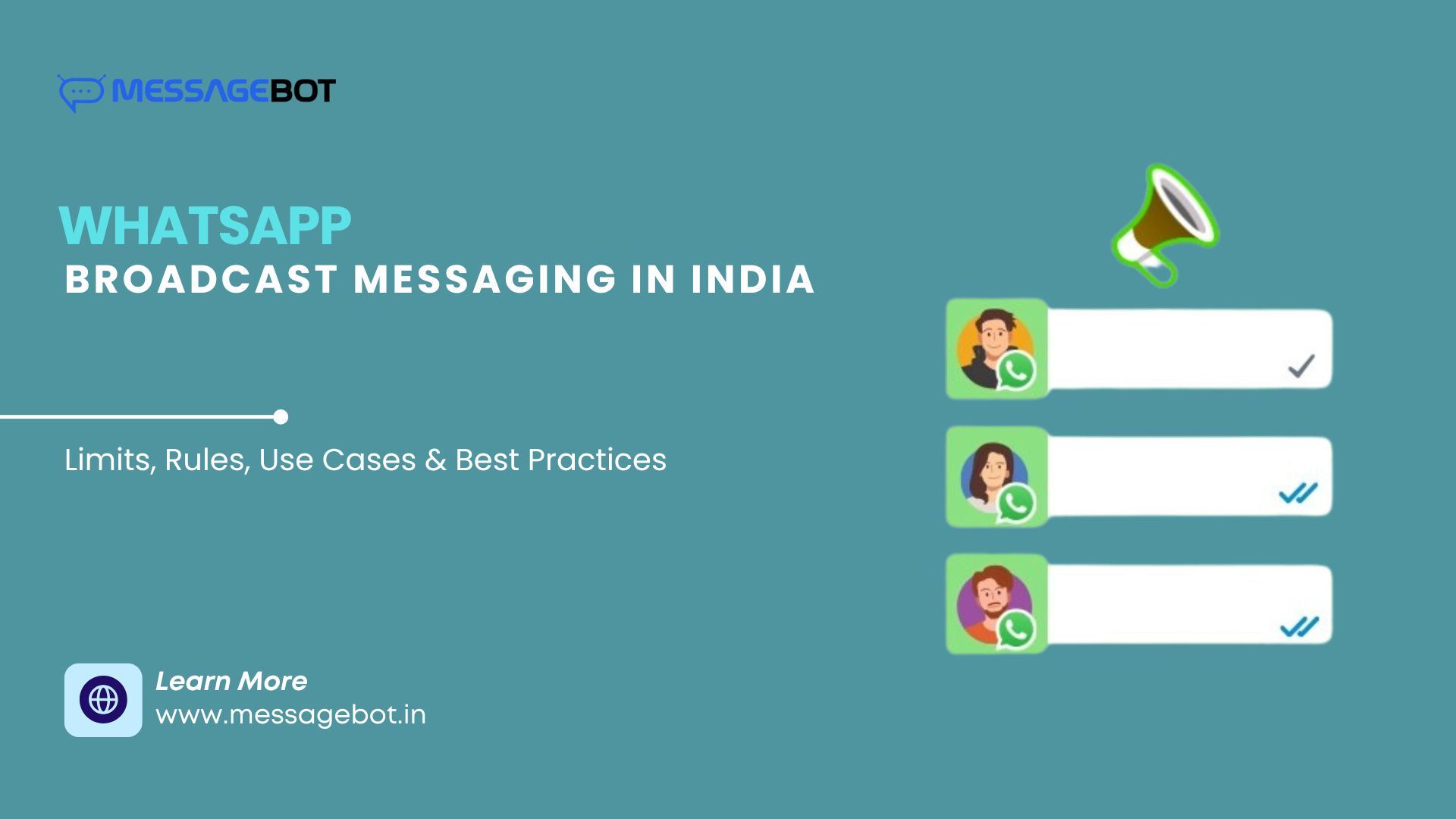 This editorial guide breaks down WhatsApp Broadcast messaging from a technical and operational lens, focusing specifically on the needs of Indian businesses in 2026. It analyzes functionality, compliance rules, performance behavior, and scaling challenges, and it clarifies when broadcasts are sufficient versus when organizations typically transition to the WhatsApp Business API
Understanding WhatsApp Broadcast
WhatsApp Broadcast is essentially a one-to-many messaging mechanism operating inside the WhatsApp Business App. It lets businesses send the same message to multiple recipients, but without creating a group or exposing recipient identities. Technically, the broadcast behaves as a set of parallel 1:1 message deliveries, each going to an individual chat window.
A key design principle:
WhatsApp Broadcast is built for lightweight outreach, not large-scale communication.
It is specifically tailored for businesses that meet the following conditions:
- Customer lists are small or moderately sized
- Messaging frequency is low or occasional
- Recipients personally know the business or have saved its number
- No automation workflows or CRM integrations are required
In India, this includes hyperlocal retailers, home-run service providers, coaching institutes, medical practices, and niche D2C brands in their early stages.
Despite its simplicity, broadcast messaging carries an operational advantage: it leverages the inherent trust of WhatsApp’s interface. Messages appear in the main chat list, not in a “promotions” tab or spam folder. For many customers, this makes the communication feel more direct and credible.
But that credibility is exactly why WhatsApp limits how broadcast messaging works — and why understanding those limits is essential for any business that uses the feature regularly.
How WhatsApp Broadcast Works
On both Android and iOS, a business can create a broadcast list and add up to 256 contacts. The system stores these lists within the WhatsApp Business App, allowing teams to re-use them for recurring updates.
The delivery model is straightforward:
- The business selects a broadcast list
- A single message is composed
- WhatsApp sends it individually to each contact
- Replies arrive in separate 1:1 threads
This model ensures that the communication remains private, aligned with WhatsApp’s emphasis on personal messaging. It also keeps the interaction manageable for businesses that depend on conversational follow-up.
However, the system carries several foundational constraints that remain unchanged in 2026 — because they are design decisions, not temporary limitations.
Broadcast Limitations in 2026: What Indian Businesses Must Understand
1 Delivery Requires the User to Save the Sender’s Number
Broadcast messages only deliver to contacts who have saved the business’s number in their phonebook. For a business, this introduces three operational challenges:
- New leads rarely save numbers immediately
- Existing customer lists may shrink as users change devices
- Dormant customers may not remember where the number came from
This rule dramatically affects broadcast-based marketing because delivery is no longer about list size — it’s about how many recipients actually have the business saved.
This limitation is one reason many mid-sized Indian businesses eventually shift to structured messaging workflows through the WhatsApp API.
our detailed guide on WhatsApp Business API in India explains this upgrade path.
2 256-Recipient Cap Per Broadcast List
Each broadcast list supports up to 256 contacts. This cap applies across Android and iOS globally.
At first glance, 256 may seem manageable. But as soon as a business wants to reach 2,500 customers, it requires multiple lists, repeated content sending, and manual monitoring of replies.
WhatsApp intentionally keeps this constraint because broadcast is meant for limited outreach, not bulk messaging.
3 No Personalization or Dynamic Fields
Broadcasts send the exact same message to every recipient, with no way to add personalized fields such as customer names or order details.
Businesses that rely on contextual messaging often adopt template-based communication through the WhatsApp API.
our blog on WhatsApp Message Templates in India already explains how personalized and approved templates work.
4 No Analytics or Delivery Reporting
Businesses cannot track:
- Delivery
- Failure
- Reads
- Clicks
This makes optimization difficult. You can only rely on manual interpretation of responses.
5 No Integrations
Broadcast lists cannot sync with a CRM, e-commerce system, billing tool, or automation platform.
Growing businesses that need workflows, segmentation, or automated replies typically transition to a structured API setup.
our article WhatsApp Chatbot for Business Automation already covers automated flows in detail.
6 Spam Protection & Enforcement
WhatsApp actively monitors account behavior. Repetitive or non-contextual broadcast messages may result in warnings or temporary restrictions.
Meta has announced stronger spam controls across emerging markets, including India, in 2026.
Suitable Use Cases for WhatsApp Broadcast in India (2026)
WhatsApp Broadcast remains valuable for:
1 Local Announcements
Operational updates such as store hours or stock availability.
2 Time-Sensitive Promotions
Flash sales, limited-time offers, and last-minute deals.
3 Community-Based Communication
Coaching centers, fitness trainers, and specialized services.
4 Appointment Reminders
Dentists, stylists, clinics, and home-service providers.
5 Customer Retention Messaging
Sharing updates with customers who already trust the business.
When Broadcast Stops Being Enough
Broadcast usage typically becomes inefficient when:
- contact lists exceed 1,000+ users
- personalization becomes essential
- analytics become necessary
- reply volume becomes high
- automation is required
This is the point where most Indian businesses evaluate the API layer.
our analysis on WhatsApp Business API Pricing in India covers message categories, charges, and scaling costs.
Best Practices for WhatsApp Broadcast Messaging (2026)
1 Maintain Verified Opt-Ins
Always ensure the recipient has agreed to receive updates.
2 Encourage Number Saving
Delivery depends on this.
3 Keep Messaging Contextual
Avoid generic or promotional spam.
4 Limit Frequency
High frequency increases account risk.
5 Use Media Wisely
Lightweight visuals perform best.
6 Maintain List Hygiene
Remove inactive numbers periodically.
7 Document Opt-In Proof
Essential for regulated industries.
Broadcast vs WhatsApp API (Technical Comparison)
| Capability | Broadcast | WhatsApp API |
| Delivery | Requires number saved | No requirement |
| Limit | 256 contacts | Unlimited |
| Personalization | None | Fully supported |
| Automation | None | Full workflows |
| Integrations | No | Yes |
| Analytics | No | Yes |
| Templates | Not allowed | Required |
| Green Tick | No | Supported |
Transition Path for Growing Indian Businesses
Typical progression:
- Early stage: Broadcast-only
- Growth: Manual reply overload
- Scaling: Automation + segmentation
- Mature: API-first infrastructure
Your blog WhatsApp OTP Service in India is a good example of how businesses handling verification workflows eventually move beyond the broadcast layer.
Conclusion
WhatsApp Broadcast remains a reliable and straightforward tool in 2026 for Indian businesses that operate on personal trust and smaller customer bases. Its limitations — including delivery dependencies, absence of analytics, and capped list sizes — are intentional design choices, not gaps.
Broadcast fulfills its purpose well when used thoughtfully and responsibly. But as businesses grow, require personalization, or need automation and performance insights, they naturally fit better within the WhatsApp API ecosystem.
If your team is evaluating a structured, scalable messaging framework beyond broadcasts, you can explore the capabilities of the WhatsApp Business API here