
The promise of a WhatsApp chatbot sounds straightforward: automate customer conversations, reduce agent load, answer queries at 3am without hiring night shift staff. And for specific, well-defined workflows, that promise is real.
The part most guides skip: chatbots also fail in predictable ways. A poorly designed chatbot frustrates users, generates high block rates, damages your WhatsApp quality rating, and can restrict your account's messaging capacity. In India specifically — where customers switch languages mid-conversation, ask open-ended questions, and have low tolerance for irrelevant automated responses — chatbot design requires more thought than connecting an API and writing a few keyword triggers.
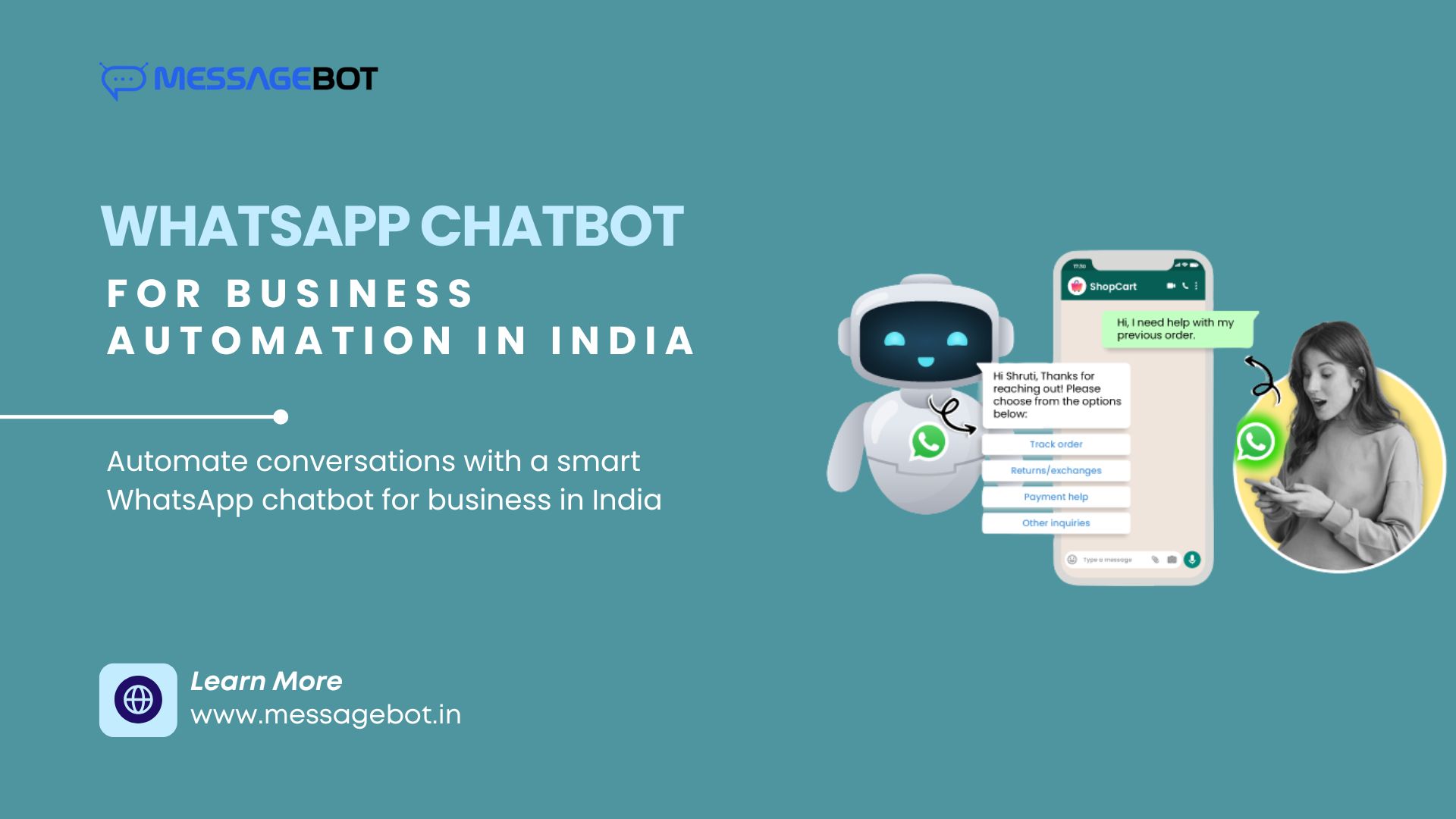
This guide covers what WhatsApp chatbots actually do, where they work well for Indian businesses, where they break down, and what the implementation actually involves.
What a WhatsApp Chatbot Is (and Isn't)
A WhatsApp chatbot is an automated system connected to your WhatsApp Business API that responds to incoming messages based on rules, keywords, or AI-powered intent detection.
What it can genuinely do well:
Answer the same question thousands of times without degradation in response time or quality
Retrieve live data from your backend (order status, account balance, appointment slots) and present it in a conversation
Collect structured information from users (name, phone, email, query type) before routing to an agent
Send proactive notifications and follow up with users inside the 24-hour service window at no per-message cost
Handle the first layer of support so agents spend time on complex queries rather than "what's my order status"
What it cannot do without careful design:
Handle open-ended, unstructured queries without NLP training
Switch languages mid-conversation unless explicitly built for it
Replace human judgment for complaints, refunds, or anything requiring empathy
Guarantee delivery if your WhatsApp quality rating is low — block rates from frustrated chatbot users directly affect your account's sending capacity
The Two Types of Chatbots: Which One You Actually Need
Rule-based chatbots work through keyword matching and decision trees. User sends "order status" → bot fetches order data and responds. The user presses button 1 → bot shows menu option 1. Predictable, reliable, and sufficient for the majority of Indian business chatbot use cases.
Rule-based is the right choice when:
Your query types are predictable and finite (order tracking, appointment booking, FAQ, lead collection)
You need fast deployment without extensive training data
Your user base has varying literacy levels — structured menus work better than free-text inputs
You want low failure rates — rule-based bots don't hallucinate or go off-script
AI-powered chatbots use NLP to understand intent from free-text input. User types "mujhe mera order track karna hai" in Hindi → bot identifies order tracking intent and responds. Handles varied phrasing, mixed language, and open-ended queries.
AI is the right choice when:
Your query types are varied and unpredictable
You have sufficient training data from real customer conversations
You can invest in ongoing tuning — NLP models degrade without maintenance as language patterns change
You have a graceful fallback to a human agent when confidence is low
Most Indian businesses start with rule-based and add AI capabilities to specific flows over time. Starting with AI for everything is expensive, slow to deploy, and often overkill for structured customer service workflows.
Where WhatsApp Chatbots Work in India
Order tracking and status updates — the highest-volume, most repetitive support query for e-commerce and logistics. A chatbot that integrates with your order management system and returns live status in response to "where is my order" handles this better than a human agent because it's instant, available at midnight, and never gets tired. How bulk SMS works alongside WhatsApp for these same notification flows — SMS for the outbound alert, WhatsApp chatbot for inbound status queries — is a common architecture.
Lead qualification — collecting name, phone, requirement, and budget from an inbound WhatsApp message before routing to a sales team. Real estate, education, insurance, and financial services use this extensively. The chatbot does the first-touch qualification; humans close. Conversion from WhatsApp lead to sales call is significantly higher than web forms because the user is already in a conversation context.
Appointment booking and reminders — healthcare clinics, service centres, and education platforms. Chatbot collects preferred date/time, checks availability via API, confirms booking, and sends reminders at configured intervals. Reminder flows inside the 24-hour service window (when the patient last messaged) cost nothing.
FAQ automation — returns policy, shipping timelines, business hours, product specifications, pricing. Content that doesn't change often and gets asked constantly. A chatbot handling these frees agents for queries that actually need human judgment.
Payment reminders and collections — fintech, NBFCs, and subscription businesses. Automated payment due reminders, EMI alerts, and payment confirmation flows work well because the user expects these messages and the response to them is structured.
Where WhatsApp Chatbots Fail
Complaint resolution — a user who's angry about a wrong delivery or a billing error does not want a chatbot. They want acknowledgement, accountability, and resolution. A chatbot that responds to "I got the wrong product" with a menu asking them to "select from options 1–4" will be blocked. Blocked users damage your quality rating. Design the chatbot to detect negative sentiment and route immediately to a human agent.
Complex multi-turn conversations — a loan eligibility query involves back-and-forth across multiple factors. A chatbot handling this without good NLP will lose context, repeat questions, and frustrate the user. Either don't automate this flow or invest in the NLP quality to handle it well.
Mixed language conversations — Indian users routinely switch between English and Hindi (or other regional languages) mid-conversation. "What is my order status" followed by "deliver kab hoga" in the same session. Rule-based bots fail here. AI bots handle it if trained on Hinglish and regional mix data specifically — most off-the-shelf NLP models are not.
Low-trust contexts — some verification and consent flows require the user to trust they're talking to a legitimate business representative. A chatbot that doesn't clearly identify itself as automated, or that asks for sensitive information without context, generates refusals and complaints.
The Quality Rating Problem
This is the most important technical consideration that most chatbot guides don't mention.
Meta tracks how recipients respond to your WhatsApp Business account. If users block your number, report your messages, or consistently don't engage, your quality rating drops from Green to Yellow to Red. A Red quality rating restricts your daily messaging capacity — potentially to a few hundred messages per day regardless of your plan.
A poorly designed chatbot is one of the fastest ways to damage quality rating:
Sending unsolicited messages to users who didn't opt in
Responding to inbound messages with irrelevant automated replies
Failing to provide a human handover option when users request it
Sending marketing content inside what should be service conversations
Design your chatbot with quality rating in mind. Every blocked user is a small tax on your entire WhatsApp channel's capacity.
Human Handover: Non-Optional
Every WhatsApp chatbot needs a clear escalation path to a human agent — and users need to know it exists.
The trigger for handover:
User explicitly asks for a human ("agent chahiye", "human se baat karo", "representative")
Negative sentiment detected in message text
Query type that falls outside defined bot capabilities
User has tried the same query twice without satisfaction
When handover triggers, the agent should see the full conversation context — not start from scratch. A chatbot that escalates with no context wastes the agent's time and frustrates the user who has to repeat everything.
If your platform doesn't support agent inbox with conversation history, the chatbot's usefulness is limited to fully automated flows that never need escalation.
Integration with Other Channels
WhatsApp chatbot works best as one layer in a broader communication system, not in isolation.
The omnichannel messaging architecture that works for Indian businesses combines the chatbot's inbound conversation handling with outbound notifications via WhatsApp templates, SMS fallback for users not on WhatsApp, and Voice OTP for verification flows where the chatbot has confirmed a transaction that needs authentication.
A practical example: a user messages your chatbot asking about loan status. The chatbot retrieves the information and responds. If the user wants to make a payment, the chatbot initiates a payment link flow. Before the payment is processed, WhatsApp OTP authentication confirms identity. If the OTP fails to deliver, SMS OTP triggers automatically. The chatbot, OTP, and SMS fallback are three separate integrations working as one flow.
What Implementation Actually Involves
Getting a WhatsApp Business API account and a basic chatbot running takes a few days if documentation is clear and your BSP onboarding is smooth. Getting a chatbot that actually works for your users takes longer.
What takes time:
Mapping all the conversation flows your users actually need — not the ones you assume they need
Building the backend integrations (order management, CRM, payment systems) that make responses dynamic
Testing with real users in your target demographic before going live
Iterating on the flows that generate complaints or low engagement in the first weeks
What to ask your BSP:
Do they provide a chatbot builder or is it pure API?
Is there a shared inbox for agent handover?
What analytics are available — conversation completion rate, handover rate, user drop-off points?
What's the process for updating conversation flows after launch?
How is quality rating monitored and what alerts exist?
MessageBot provides WhatsApp Business API access with chatbot integration capability for Indian businesses.
Conclusion
A WhatsApp chatbot that handles order tracking, lead qualification, and appointment booking well is genuinely valuable — it reduces support load, improves response time, and scales without hiring. The businesses that get the most from WhatsApp automation are the ones that start with specific, well-defined use cases rather than trying to automate everything at once.
The ones that struggle are the ones that deploy a chatbot without a human handover path, without quality rating monitoring, and without the backend integrations that make responses actually useful. A chatbot that can't tell a user their order status and can't connect them to someone who can is worse than no chatbot — it's an active frustration driver.
Start narrow. Automate the highest-volume, most repetitive queries first. Add complexity after you've validated that the basic flows work for your actual users.