
Most businesses only start thinking about SMS routing after something breaks. An OTP arrives thirty seconds late during a flash sale. Transaction alerts suddenly stop reaching users on one operator while working perfectly on another. Delivery reports show “submitted,” but customers insist no message was received. Support teams blame APIs, developers blame operators, and providers blame DLT systems.
In reality, SMS delivery in India involves multiple telecom layers working together in real time. By the time a message reaches a handset, it has already passed through APIs, gateways, DLT validation engines, operator SMSCs, queueing systems, filtering rules, and routing decisions.
 That complexity is invisible when traffic is low. It becomes very visible when businesses start operating at scale. This is why understanding SMS routing is important today, especially for businesses handling OTP authentication, banking alerts, logistics notifications, healthcare reminders, and transactional communication flows. Because in Indian telecom infrastructure, message delivery is not controlled by a single system. It is shaped by the entire routing chain.
What Is SMS Routing?
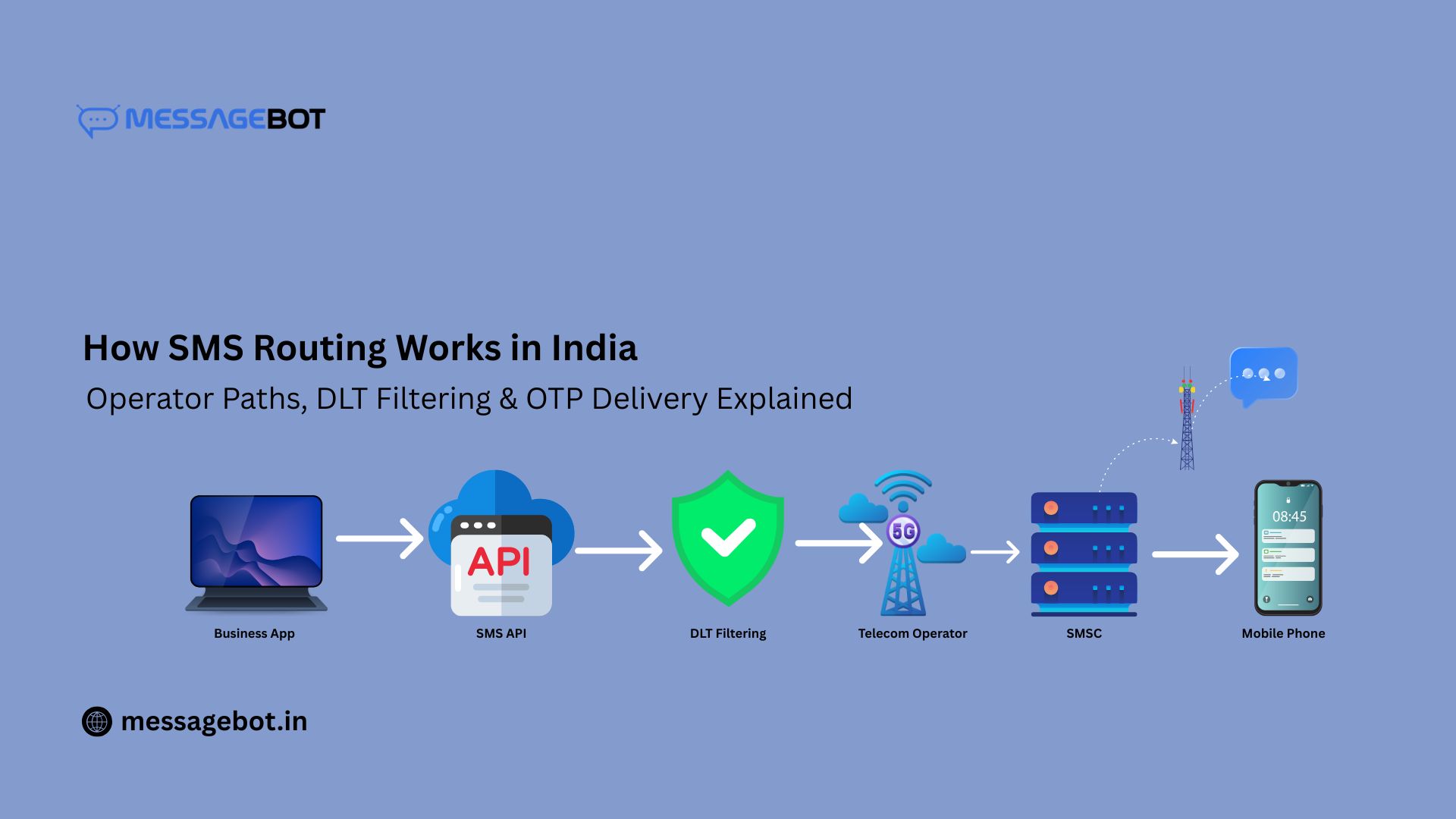
SMS routing is the process through which an SMS message travels from a business application to the recipient’s mobile device through telecom infrastructure. A typical delivery flow in India usually looks like this:
Application → SMS API → SMS Gateway → DLT Scrubbing → Operator SMSC → Mobile Network → Recipient Device
Each layer performs a different responsibility. The API receives the request from the application. The gateway decides how traffic should be routed. DLT systems validate templates and sender identities. Operator SMSCs process queueing and delivery attempts. Finally, the mobile network pushes the message to the handset. This entire process usually completes within seconds.
But even a small disruption at one layer can affect final delivery speed. That is why businesses scaling authentication systems often focus heavily on SMS API integration architecture instead of treating messaging as a simple notification layer.
Why SMS Routing Became More Complex in India
A few years ago, enterprise SMS delivery in India was comparatively simpler. Then DLT regulations changed the ecosystem completely.
Today, telecom operators validate:
- sender IDs
- business entities
- approved templates
- traffic categories
- consent structures
before traffic is allowed into operator networks. This additional compliance layer improved spam control, but it also introduced more routing dependencies. Now a message can fail even before operator delivery begins.
For example, a business may submit traffic correctly through the API, but the message still gets blocked because:
- the template wording changed
- variables were structured differently
- the sender ID mismatched
- the template category was incorrect
These problems are now extremely common inside Indian messaging systems, especially for businesses unfamiliar with DLT template approval workflows.
How an SMS Actually Travels Through Indian Telecom Networks
When an application triggers an SMS request, the first stop is usually the SMS API layer.
At this stage, the platform validates:
- API credentials
- sender permissions
- template mappings
- traffic type
- routing eligibility
Once validated, the traffic moves toward the SMS gateway infrastructure.
The gateway acts like a routing controller. It determines:
- which operator path should be used
- which queue should handle traffic
- whether fallback routes are required
- how throughput should be balanced
This is where routing quality starts becoming important. A weak routing setup may overload one operator path while another remains underutilized. Better systems intelligently distribute traffic depending on operator conditions, congestion levels, and delivery behaviour.
After routing decisions are made, the message moves into DLT scrubbing systems where content verification begins. Only after successful validation does the traffic reach operator SMSCs. The SMSC - Short Message Service Center acts as the operator’s internal message processing system. It temporarily stores, forwards, retries, and manages SMS traffic before final handset delivery. This is also where queueing delays often begin during high-volume traffic periods.
Why OTP Messages Get Delayed During Peak Traffic
OTP traffic behaves differently from normal promotional messaging. Authentication systems are extremely time-sensitive. Even a few seconds of delay can reduce login success rates, payment completion, or onboarding conversions. In India, OTP delays usually happen because one or more routing layers become congested.
Common causes include:
- DLT validation congestion
- operator queue overload
- poor routing prioritization
- TPS saturation
- weak retry systems
- filtering triggers
- overloaded fallback routes
These issues become highly visible during periods of massive traffic spikes such as Diwali sales, IPL campaigns, ticket launches, banking peaks, government application deadlines, and large ecommerce events where telecom networks suddenly process millions of authentication requests simultaneously. During these periods, telecom queues process enormous traffic bursts simultaneously. Businesses experiencing recurring OTP delivery failures across operators often discover that the issue is not the API itself, but congestion deeper inside routing systems.
Understanding Direct Routes vs Grey Routes
Not all SMS traffic in India travels through the same quality infrastructure. Some providers use direct operator routes with approved telecom connectivity. Others depend partially on grey routes to reduce costs.
This difference affects:
- delivery speed
- DLR accuracy
- filtering risk
- delivery consistency
- OTP reliability
Grey routes may appear cheaper initially, but they often create unstable delivery behaviour during high-traffic periods. This is why businesses handling sensitive traffic — especially banking, fintech, healthcare, and authentication systems increasingly avoid providers using unverified routing paths. Reliable routing is usually invisible when everything works. It becomes obvious only when delivery starts failing.
The Role of SMSCs in Message Delivery
SMSC stands for Short Message Service Center. Most businesses never hear about SMSCs until they start debugging delivery problems.
Inside telecom infrastructure, SMSCs are responsible for:
- storing messages temporarily
- retrying failed deliveries
- forwarding traffic to devices
- handling queue management
- generating delivery acknowledgements
Every operator maintains its own SMSC infrastructure. During high traffic periods, SMSCs may delay lower-priority traffic while prioritizing transactional or authentication routes.
This is why delivery behaviour sometimes differs between:
- Airtel
- Jio
- Vodafone Idea
- BSNL
Even when the same provider sends the message. Operator-level queue management directly affects delivery timing.
Why Delivery Reports Matter in Routing Systems
A successful API response only confirms message acceptance by the platform. It does not confirm handset delivery that is why DLRs - Delivery Reports are operationally important.
DLRs help businesses understand:
- whether the handset received the message
- whether the operator rejected traffic
- whether the message expired in queue
- whether filtering blocked delivery
Businesses monitoring delivery report visibility across telecom operators often identify routing problems much faster than teams relying only on dashboard-level metrics. For OTP systems especially, DLR analysis becomes essential because delivery timing directly affects authentication success.
Why Throughput and TPS Matter
TPS means Transactions Per Second. In messaging infrastructure, TPS determines how many messages a platform can process every second.
This becomes extremely important for:
- banks
- fintech apps
- ecommerce platforms
- ticketing systems
- government services
- large-scale authentication platforms
If traffic volume exceeds routing capacity, queue delays begin immediately. Some providers advertise unlimited scalability but still operate on weak routing infrastructure underneath.
This is why businesses scaling messaging systems usually test:
- throughput stability
- queue handling
- operator balancing
- retry behavior
- DLR accuracy
before committing to large-scale deployments.
How Telecom Operators Filter SMS Traffic
Indian telecom operators do not process all traffic equally.
Filtering systems constantly evaluate:
- spam behaviour
- route quality
- content patterns
- template compliance
- sender reputation
- abnormal traffic spikes
This is one reason businesses sometimes notice sudden delivery drops even when applications appear technically correct.
For example:
- unusual OTP retry bursts
- excessive duplicate messages
- unauthorized templates
- abnormal promotional behaviour
may trigger filtering systems automatically.
Businesses handling transactional and promotional traffic separately generally experience better routing consistency because operator systems categorize and prioritize traffic differently.
Why SMS Routing Is Becoming a Competitive Advantage
A few years ago, businesses mostly compared SMS providers by pricing. That is changing rapidly. Today, delivery consistency matters more than simply sending large message volumes cheaply. For fintech companies, logistics platforms, healthcare systems, ecommerce brands, and SaaS platforms, communication reliability directly affects customer trust.
That is why modern communication infrastructure increasingly focuses on:
- intelligent routing
- operator balancing
- fallback systems
- multi-channel delivery
- real-time analytics
- queue optimization
- delivery visibility
Many businesses now combine SMS with WhatsApp-based authentication systems, voice fallback channels, and push notifications to reduce dependency on a single routing layer. The future of enterprise communication in India will not belong to platforms that simply “send SMS.” It will belong to platforms that understand telecom delivery infrastructure deeply.
The Future of SMS Routing in India
Indian messaging infrastructure is evolving quickly.
Over the next few years, routing systems will become increasingly dependent on:
- AI-based traffic optimization
- intelligent queue balancing
- automated failover routing
- fraud detection systems
- real-time operator analytics
- adaptive throughput allocation
At the same time, businesses are expanding toward richer communication ecosystems involving:
- SMS
- Voice APIs
- RCS messaging
- push notifications
- omnichannel workflows
But despite this evolution, SMS routing remains foundational because telecom-level reach is still unmatched for authentication and critical transactional communication. This is especially true for businesses building omnichannel communication infrastructure where SMS continues acting as the most reliable fallback layer.
Conclusion
SMS routing in India is far more complex than most businesses initially assume. Behind every OTP, banking alert, delivery notification, or transactional message is a telecom routing chain involving APIs, gateways, DLT systems, operator SMSCs, queue management, filtering engines, and handset delivery acknowledgements.
For growing businesses, understanding this infrastructure is becoming increasingly important. Because reliable communication today is not only about sending messages. It is about ensuring those messages consistently reach users during real-world traffic conditions. And in India’s telecom ecosystem, routing quality often determines that outcome long before the customer ever sees the message.