
For nearly three decades, SMS has carried India's business communication — OTPs, transaction alerts, delivery updates, promotional offers. It works on every phone, needs no internet, and reaches every number. But it has never been able to show a brand logo, display a product image, or let a customer tap a button to confirm a delivery without leaving the message thread.
RCS changes that. Not by replacing SMS, but by upgrading it — delivering WhatsApp-level interactivity through the phone's default messaging app, with no installation required.
In 2026, RCS crossed from pilot to production in India. All three major operators — Jio, Airtel, and Vi — fully support RCS Business Messaging. Over 550 million Android devices in India are RCS-enabled. Apple's iOS 18 brought iPhones into the ecosystem. And Airtel's March 2026 partnership with Google added carrier-level AI spam filtering — making India one of the most robust RCS markets globally.
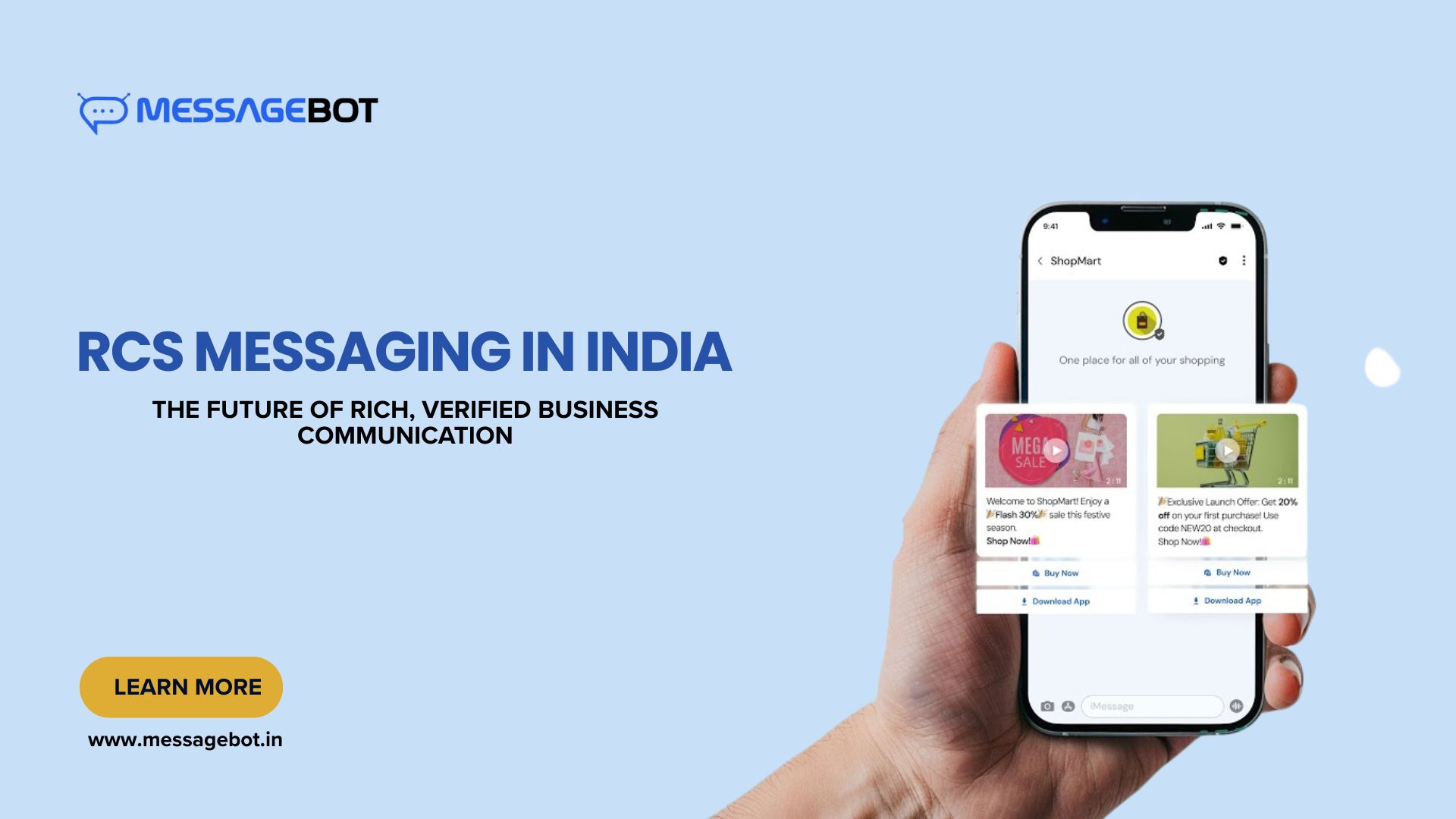
This guide explains everything a business needs to know: what RCS is, how it works, how India's ecosystem looks today, what it costs, how it compares to SMS and WhatsApp, and how to decide whether to adopt it now or later.
What Is RCS Messaging?
RCS stands for Rich Communication Services. It is the official successor to SMS and MMS, developed by the GSMA — the global mobile industry association — as an open standard built directly into the native messaging app on smartphones.
Unlike SMS, which sends plain text through the telecom operator's signalling network, RCS uses mobile data (4G/5G or Wi-Fi) to deliver rich, interactive messages that include:
Verified sender identity — brand name, logo, and a verified checkmark visible before the message is even opened
Rich media — high-resolution images, videos, GIFs, audio files
Interactive elements — quick reply buttons, call-to-action buttons, suggested replies
Carousels — scrollable cards with individual images, text, and CTAs (up to 10 cards per message)
Read receipts and delivery confirmation — more granular than SMS DLRs
Longer messages — no 160-character limit
Two-way conversation — customer can respond within the same thread
The critical distinction from WhatsApp: RCS requires no app download, no account creation, no opt-in beyond having a compatible device and carrier. The message arrives in the same inbox where SMS arrives — just richer.
The History of RCS: From 2007 to India's 2026 Moment
RCS was first proposed in 2007 by the GSMA as an upgrade to SMS. The vision was straightforward — give mobile messaging the features that internet-based messaging already had. Early adoption was slow. Carrier fragmentation, lack of universal standards, and the explosive growth of OTT apps like WhatsApp in the early 2010s kept RCS marginal for years.
The inflection point came in 2016 when Google integrated RCS into Android Messages (now Google Messages) and began pushing operators globally to adopt the Universal Profile standard. This gave RCS a single consistent implementation across devices and carriers for the first time.
In India, Reliance Jio was one of the first carriers globally to launch RCS support, partnering early with Google to bring the feature to millions of Indian users as far back as 2019. Airtel and Vi followed. By 2021, all three major operators had enabled RCS for peer-to-peer messaging.
RCS Business Messaging — the A2P (application-to-person) commercial layer that lets companies send branded messages — took longer. The challenge was not technical but regulatory: operators wanted spam controls before opening the channel to bulk business senders. Airtel had until recently avoided partnering with Google for RCS enablement, arguing that encrypted communication channels could potentially allow spam to bypass existing safeguards.
That changed in March 2026. Airtel and Google agreed to integrate RCS traffic with Airtel's AI-driven spam filter — a key requirement that had previously held up the collaboration. With this development, all three major Indian telecom operators — Airtel, Reliance Jio, and Vodafone Idea — have now adopted RCS, strengthening the foundation for a more competitive business messaging ecosystem.
2026 is the year RCS Business Messaging became a real, production-grade channel in India.
RCS vs SMS vs MMS vs WhatsApp: The Complete Comparison
Understanding where RCS sits in the messaging landscape requires comparing it against every channel it overlaps with.
Feature | SMS | MMS | WhatsApp Business | RCS |
Requires app install | No | No | Yes | No |
Requires opt-in | No | No | Yes | No |
iOS support | Yes | Yes | Yes | iOS 18+ |
Android support | Yes | Yes | Yes | Android 5.0+ |
Verified sender | No | No | Yes (BSP) | Yes (Google) |
Rich media | No | Images only | Full | Full |
Interactive buttons | No | No | Yes | Yes |
Carousels | No | No | Yes | Yes |
Read receipts | No | No | Yes | Yes |
Character limit | 160 | Higher | None | None |
DLT compliance (India) | Required | Required | Not required | In transition |
Works without internet | Yes | Yes | No | No |
Cost per message | Low | Low-Medium | ₹0.115–₹0.8631 | ₹0.25–₹0.45 (est.) |
Fallback channel | None | None | SMS | SMS |
The honest summary:
SMS wins on universal reach and no-internet delivery. WhatsApp wins on two-way conversation depth, established opt-in infrastructure, and India's existing user behaviour (500M+ active users). RCS wins on reaching Android users with rich content without requiring app installation or prior opt-in — the unique position no other channel occupies.
Will RCS replace SMS? No. RCS requires mobile data — SMS does not. Automatic SMS fallback is a mandatory component of any RCS deployment precisely because RCS cannot reach every device. The two channels are complementary, not competitive.
Will RCS replace WhatsApp in India? Also no — at least not soon. WhatsApp has deep behavioural roots in India. Customers initiate conversations on WhatsApp. Businesses have built support flows on it. RCS's advantage is reaching users who haven't opted in to WhatsApp Business — a genuinely different audience segment, particularly for promotional outreach.
RCS in India: The Current State (2026)
Operator Support
All three of India's major telecom operators — Reliance Jio, Bharti Airtel, and Vodafone Idea (Vi) — have fully enabled RCS on their networks through the Google Jibe infrastructure as of 2026. BSNL has also announced plans to enable RCS support, which will further expand RCS coverage into segments of the Indian subscriber base that currently rely exclusively on BSNL's network.
Device Reach
India has over 550 million Android smartphone users, making it the single largest Android user base on the planet. Android holds over 90% of India's smartphone market. Since RCS is natively built into Google Messages — the default messaging app on most Android devices — the potential reach of an RCS campaign in India is substantial.
Apple added native RCS support in iOS 18 (September 2024). For Indian iPhone users on iOS 18 and later, RCS Business Messaging delivers verified sender badges and core rich features. Full RCS Business Messaging parity between Android and iOS is still being rolled out, but the gap that previously made RCS an Android-only channel has closed significantly.
Geographic Coverage
RCS is fully live in India, supported by Jio, Airtel and Vi, with over 500 million RCS-enabled devices across more than 1,000 cities. Coverage is strongest in metro and Tier-1 cities. Vi's rollout in semi-urban areas is still maturing — Vi RCS requires 4G connectivity, meaning 3G or 2G areas will not receive RCS (and will fall back to SMS automatically).
Automatic SMS Fallback
Every serious RCS platform automatically detects whether a recipient's device and operator support RCS before sending. If they don't, the message falls back to SMS — preserving 100% delivery reach while delivering the rich experience only where it's supported. Businesses pay RCS rates only for messages actually delivered as RCS.
How RCS Business Messaging Works
The architecture behind an RCS business message involves four layers working together:
1. Google RCS Business Messaging (RBM) infrastructure — Google operates the core RCS delivery infrastructure globally, including brand verification and the agent profile system that gives businesses their verified identity.
2. Telecom operator network — Jio, Airtel, or Vi receives the RCS message from Google's infrastructure and delivers it to the subscriber's device via their 4G/5G network.
3. Google Messages app — renders the rich content (images, buttons, carousels) in the recipient's native messaging inbox. No third-party app needed.
4. BSP/aggregator platform — your business connects to Google RBM through a verified partner that handles brand registration, message sending, analytics, SMS fallback, and DLT compliance.
When a customer taps a button in an RCS message — "Track Order," "Confirm Appointment," "View Offer" — that interaction is captured and returned to your system via webhook. The entire transaction happens inside the native messaging app.
RCS Features for Indian Businesses: What You Can Actually Send
Standalone Rich Cards A single card with a header image, title text, body text, and up to 4 CTA buttons. Standard for individual product announcements, appointment confirmations with action buttons, or verified alerts with one clear next step.
Carousels Two to ten horizontally scrollable rich cards in a single message. Each card has its own image, text, and buttons. Used for product catalogues, multi-option offers, multi-destination travel packages, or any scenario where the customer needs to choose from a set of options.
Quick Replies Pre-defined response options the customer can tap — "Yes, confirm," "No, reschedule," "Call me back." Eliminates typing and dramatically increases response rates on two-way flows.
CTA Buttons
Open URL — launches a web page within the message interface
Dial number — initiates a phone call
View location — opens Google Maps
Share location — customer shares their location
Calendar event — adds an event directly to the customer's calendar
Verified Sender Profile Your brand name, logo, tagline, and a Google-verified checkmark appear with every message — before the customer opens it. This is the trust signal that SMS sender IDs cannot replicate.
RCS Pricing in India (2026)
RCS messages cost more per send than bulk SMS — but the comparison that matters is cost per conversion, not cost per message.
RCS typically costs ₹0.25–₹0.45 per message versus ₹0.10–₹0.18 for SMS. But higher click-through rates (25–40% vs 1–3% for SMS) usually mean a lower cost per conversion on high-value campaigns.
According to industry executives, Airtel levies a charge of ₹0.11 per RCS message under an 80:20 revenue-sharing arrangement with Google. Platform/aggregator fees are added on top, bringing the typical all-in rate to ₹0.25–₹0.45 depending on volume and provider.
Key pricing principles:
You pay RCS rates only for messages delivered as RCS — fallback SMS messages are billed at SMS rates
Volume discounts apply above certain monthly thresholds
18% GST applies on all charges
No DLT template registration fee for RCS (unlike SMS)
When the economics work: For promotional campaigns where click-through rate directly affects revenue — e-commerce, banking offers, travel — the higher per-message cost is typically offset by the engagement lift. A campaign that converts at 8% via RCS versus 1% via SMS generates 8x the outcome from the same audience, at 2–3x the message cost.
For transactional notifications where engagement isn't the goal (OTP delivery, account alerts) — SMS remains more cost-effective. Don't use RCS for OTPs.
Use Cases for RCS in India
E-commerce and D2C Product catalogues via carousel (new arrivals, festive collection), order status with tracking button, delivery confirmation with rescheduling option, cart recovery with product image and "Buy Now" CTA. The visual format of RCS converts significantly better than plain SMS for purchase-intent messages.
Banking and Fintech Verified fraud alerts (the verified sender badge is particularly valuable for security-sensitive communication), card offer announcements, EMI reminder with "Pay Now" button, credit card statement with "View Details" CTA. The verified identity reduces customer hesitation on financial messages.
Healthcare Appointment reminder with "Confirm" and "Reschedule" buttons, lab report ready notification with "Download Report" CTA, vaccination reminder with location card showing nearest centre. Two-way confirmation reduces no-shows without requiring phone calls.
Travel and Hospitality Booking confirmation with boarding pass card, hotel check-in details with "Get Directions" button, flight status update with rebooking option, itinerary card with multiple destination details in carousel format.
Logistics and Delivery Shipment tracking update with map link, delivery window confirmation with "I'll be home" / "Reschedule" quick replies, proof of delivery notification, failed delivery rescheduling flow.
Education Exam timetable as rich card, admission confirmation with fee payment button, result notification with "View Marksheet" CTA, fee reminder with payment link.
Setting Up RCS Business Messaging in India
Getting started involves four steps:
Step 1 — Brand Registration with Google Submit your business profile for Google verification: brand name, logo, website, description, contact information, and use case. Google reviews and approves the brand agent. Timeline: 3–7 business days typically.
Step 2 — Choose a Google RBM Partner You cannot send RCS Business Messages directly — you need a verified Google RBM partner (equivalent to a BSP for WhatsApp). The partner handles the technical integration with Google's infrastructure, carrier connections, SMS fallback, and analytics.
Step 3 — DLT Registration DLT compliance management — does the platform handle template pre-registration under the RCS/SMS DLT framework? While RCS itself operates outside the traditional DLT framework, the SMS fallback messages still require DLT-registered templates. Your platform should handle both.
Step 4 — Design and Test Build your rich card and carousel templates. Test across Jio, Airtel, and Vi devices before go-live. Verify SMS fallback renders correctly. Launch with analytics tracking CTA clicks, read rates, and response rates at the message level.
RCS Strategy for Indian Businesses: 6 Principles
1. Start with your highest-value SMS campaigns Don't migrate everything to RCS immediately. Identify your 2–3 SMS campaigns with the strongest conversion intent — promotional offers, cart recovery, appointment confirmation — and pilot RCS for those audiences first. Measure RCS versus SMS performance on the same audience before scaling.
2. Design for the button, not the image The interactive button is RCS's most powerful feature — not the image. A well-designed quick reply that lets a customer confirm a delivery in one tap is more valuable than a beautiful product image with no action path. Every RCS message should have a clear, single primary action.
3. Keep SMS fallback in mind throughout A significant portion of your audience will receive SMS fallback — older devices, Vi users in semi-urban areas, any recipient without 4G connectivity at the moment of send. Design your message so the SMS version is still coherent. The rich content is an upgrade, not a dependency.
4. Don't use RCS for OTPs Authentication requires guaranteed delivery. RCS's delivery is conditional on device and operator support. For OTPs, use the dedicated SMS OTP route or WhatsApp authentication messages — both have more predictable delivery for time-sensitive verification.
5. Segment by Android vs iOS Until RCS Business Messaging reaches full parity on iOS, segment your audience. Android users on Jio, Airtel, Vi in 4G coverage areas — these are your RCS audience. iOS users and feature phone users receive SMS. This segmentation improves your RCS delivery rate metrics and prevents diluting performance data.
6. Integrate RCS into your omnichannel stack RCS works best as a layer alongside SMS and WhatsApp, not as a replacement for either. How omnichannel messaging works for Indian businesses — using each channel where it performs best — applies directly to RCS strategy.
Common Mistakes Businesses Make with RCS
Sending OTPs via RCS — conditional delivery makes RCS unsuitable for time-sensitive authentication. Use dedicated OTP channels.
No SMS fallback configured — any RCS deployment without automatic SMS fallback is leaving a portion of your audience unreached. Non-negotiable.
Overloading carousels — 10-card carousels with dense text and 4 buttons per card overwhelm rather than engage. 3–5 cards, one primary CTA per card, concise text.
Ignoring analytics — RCS provides read receipts and button-click data that SMS cannot. Businesses that don't monitor which CTAs get tapped, which cards get scrolled to, and what the read rate is are wasting the channel's primary advantage over SMS.
Applying SMS campaign logic to RCS — SMS campaigns are optimised for reach and open rate. RCS campaigns should be optimised for interaction rate and conversion. Different metrics require different creative and different success definitions.
Not verifying your brand profile before launching — the verified sender badge is the trust foundation of RCS. Launching without completing Google brand verification means messages arrive without the checkmark — defeating one of RCS's core advantages.
Should Your Business Adopt RCS Now?
Adopt RCS now if:
You send high-volume promotional SMS to Android audiences and want to improve engagement without requiring WhatsApp opt-in
You operate in BFSI, e-commerce, or logistics where verified sender identity directly reduces customer hesitation
Your marketing team has capacity to design rich card and carousel content
You have an existing SMS infrastructure and want to upgrade specific campaigns rather than rebuild
Wait on full RCS migration if:
Your primary use case is OTP or transactional notification — SMS and WhatsApp handle these better
Your audience is predominantly rural or semi-urban where 4G coverage is inconsistent
Your tech team is already managing multiple channel integrations and adding RCS would dilute focus
You don't have analytics infrastructure to measure RCS-specific metrics (read rate, CTA click rate)
The pragmatic path for most Indian businesses: Pilot RCS on 2–3 high-value promotional campaigns alongside your existing SMS infrastructure. Measure actual delivery rate as RCS versus SMS fallback, and CTA click rate versus SMS click rate on the same audience. Scale based on data.
Conclusion
RCS has arrived in India — not as a future possibility, but as a live, scalable channel with full operator support from Jio, Airtel, and Vi, 550 million+ eligible Android devices, and iOS 18 bringing iPhones into the ecosystem.
The businesses that will benefit most from early RCS adoption are those running high-volume promotional SMS campaigns who want to upgrade the engagement experience without requiring WhatsApp opt-in, and those in sectors where verified sender identity directly addresses trust concerns — banking, insurance, healthcare, government services.
RCS is not the right channel for OTP delivery, universal reach campaigns where SMS reliability is non-negotiable, or businesses without the content capability to design rich cards and carousels properly. In those contexts, SMS and WhatsApp continue to be the right tools.
The right path for most Indian businesses in 2026: pilot on your highest-value promotional SMS campaigns, measure the actual lift in engagement and conversion versus SMS baseline, configure SMS fallback from day one, and scale based on results — not projections.
MessageBot supports RCS Business Messaging alongside SMS, WhatsApp, and Voice for Indian businesses through a single integration with automatic SMS fallback
Frequently Asked Questions
What is RCS messaging in India?
RCS (Rich Communication Services) is the upgraded successor to SMS, built into the default messaging app on Android and iPhone. It lets businesses send branded, interactive messages — images, carousels, buttons, read receipts — with a Google-verified sender identity, directly to a customer's native messaging inbox. No app download required. As of 2026, all three major Indian operators (Jio, Airtel, Vi) support RCS Business Messaging, with over 550 million RCS-enabled devices in India.
Is RCS available in India in 2026?
Yes. RCS Business Messaging is fully live in India across Jio, Airtel, and Vi networks, covering 1,000+ cities. BSNL is rolling out support. Automatic SMS fallback ensures 100% delivery reach for devices or areas where RCS is not yet available.
How is RCS different from WhatsApp Business API?
WhatsApp requires the customer to have WhatsApp installed and to have opted in to receiving business messages. RCS delivers through the native messaging app with no additional download or opt-in required. RCS also includes Google-verified sender identity — the brand logo and checkmark appear before the message is opened. The tradeoff: WhatsApp has deeper two-way conversation capabilities and a larger established user base in India for business messaging.
Does RCS work on iPhones in India?
Apple added native RCS support in iOS 18 (September 2024). Indian iPhone users on iOS 18 and later can receive RCS messages with verified sender badges and core rich features. Full RCS Business Messaging parity between Android and iOS is still maturing, but the channel is no longer Android-only.
How much does RCS messaging cost in India?
Approximately ₹0.25–₹0.45 per delivered RCS message, compared to ₹0.10–₹0.18 for bulk SMS. You only pay RCS rates for messages actually delivered as RCS — SMS fallback messages are billed at SMS rates. 18% GST applies. Contact your RCS provider for volume pricing.
Is DLT registration required for RCS in India?
RCS Business Messaging itself currently operates outside TRAI's DLT framework for commercial SMS. However, the SMS fallback component of every RCS campaign does require DLT-registered templates. A serious RCS platform handles both — RCS delivery and DLT-compliant SMS fallback — from a single integration.
Will RCS replace SMS?
No. RCS requires mobile data connectivity — SMS does not. RCS deploys with automatic SMS fallback for devices and locations where RCS is unavailable. The two channels are complementary: RCS upgrades the experience where the infrastructure supports it, SMS ensures universal delivery where it doesn't.
What is the difference between RCS P2P and RCS Business Messaging?
P2P RCS is person-to-person messaging — the same rich features (images, read receipts, typing indicators) between individual users. RCS Business Messaging (also called A2P RCS or RBM) is the commercial product — verified brand sender profiles, business-initiated messages, carousels, CTA buttons, and campaign analytics. They use the same underlying protocol but serve entirely different use cases.
Can I use my existing SMS API for RCS?
Not directly. RCS Business Messaging requires integration with Google's RBM infrastructure through a verified partner. However, providers that support both SMS and RCS can route messages through a single API — automatically selecting RCS for capable devices and falling back to SMS for others. Ask your provider whether they offer unified SMS+RCS messaging.