
A bulk SMS gateway is the infrastructure layer between your application and your customers' phones. It determines whether your OTP arrives in 3 seconds or 30, whether your campaign delivery report reflects what actually reached devices or just what left your provider's system, and whether a DLT template rejection is caught before dispatch or discovered after 50,000 messages fail silently.
Most Indian businesses discover these differences only after a bad experience. This guide covers what a bulk SMS gateway actually does, what separates good infrastructure from average, how pricing works, and which providers are worth evaluating in 2026.
What Is a Bulk SMS Gateway?
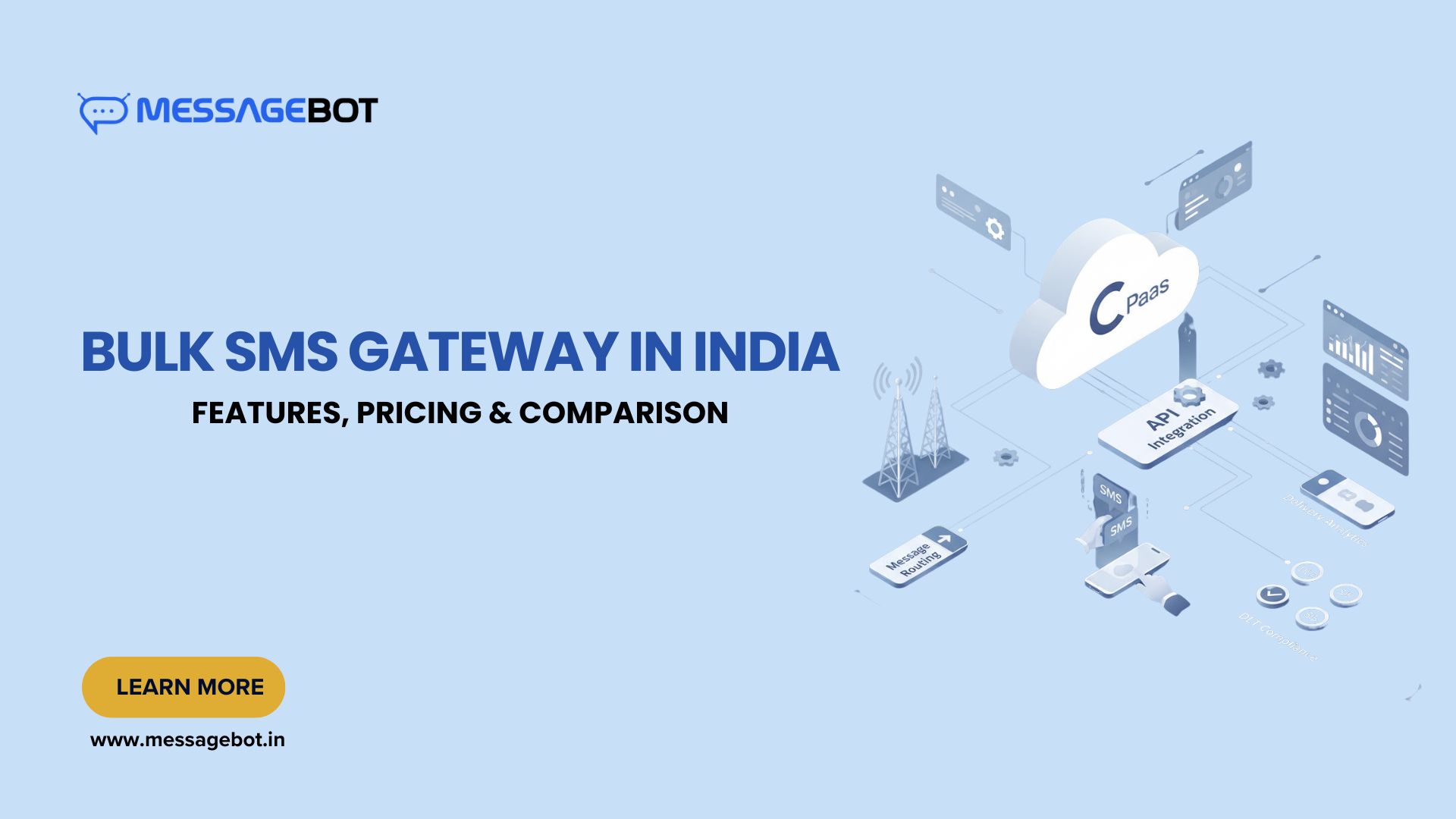
A bulk SMS gateway is a platform — cloud-hosted software plus telecom operator connections — that receives message requests from your application via API and routes them to the correct telecom operator for delivery to recipient devices.
At the infrastructure level, a gateway does several things simultaneously:
Route selection — based on the destination number's operator, the message type (OTP, transactional, promotional), and real-time operator congestion, the gateway selects the optimal path.
DLT validation — before dispatch, the message content is validated against your registered DLT template. Mismatches are caught here, not at the operator.
Operator handoff — the message is passed to the telecom operator's SMSC via SMPP protocol for final delivery.
DLR collection — delivery receipts from the operator are collected and returned to your system via webhook or API response.
The quality of each of these steps — not just the per-SMS price — determines your actual delivery performance.
What Separates a Good Gateway from an Average One
Tier-1 vs Aggregator Routing
Tier-1 gateways maintain direct SMPP connections to Indian telecom operators — Jio, Airtel, Vodafone Idea, BSNL. Messages travel from your application to the operator in one hop.
Aggregator-based gateways add one or more intermediary layers between your message and the operator. Each hop introduces latency and a potential failure point. For OTPs — where a 20-second delay is functionally equivalent to non-delivery — aggregator routing is not acceptable.
The cost difference between Tier-1 and aggregator routes is typically ₹0.02–₹0.05/SMS. At 100,000 OTPs per month, that's ₹2,000–₹5,000 extra — small relative to the cost of failed verifications.
Operator-Side vs Aggregator-Side DLRs
This distinction matters more than most businesses realise. The difference between direct and grey route SMS — and how it affects the accuracy of your delivery reports — directly determines whether your analytics reflect reality.
An aggregator-side DLR tells you the message was handed off to the next hop in the chain. An operator-side DLR confirms the message reached the recipient's device. Providers reporting 98% delivery rates using aggregator-side DLRs may have actual device delivery rates of 85–90% — and you'd have no way to know without testing.
DLT Automation Depth
India's DLT framework requires entity registration, sender ID registration, and template pre-approval before any commercial SMS can be sent. A gateway that handles all three — and automatically scrubs outgoing messages against registered templates before dispatch — prevents the most common cause of bulk SMS failure in India.
How DLT registration works in India — from entity registration to template approval — affects every message you send. A gateway that leaves this entirely to you creates ongoing compliance overhead.
API Quality
For developers integrating SMS into applications, the API is the product. A well-built SMS gateway API provides:
REST endpoints for single and bulk sends
Separate message type parameters for OTP, transactional, and promotional routes
Mandatory DLT fields (dltEntityId, dltEntityTemplateId) surfaced in the request schema
Webhook callbacks for delivery status events
Sandbox environment for testing before going live
Meaningful error codes with descriptions
Here is what a real OTP send request looks like through MessageBot's verified API:
POST http://papi.messagebot.in/SendSmsV2
Content-Type: application/json

{
  "apiToken": "YOUR_TOKEN",
  "messageType": "3",
  "messageEncoding": "1",
  "destinationAddress": "917006822667",
  "sourceAddress": "MBOTIN",
  "messageText": "Your OTP is 849201. Valid for 10 minutes.",
  "dltEntityId": "YOUR_DLT_ENTITY_ID",
  "dltEntityTemplateId": "YOUR_DLT_TEMPLATE_ID",
  "userReferenceId": "TXN_REF_001"
}

Response:
{
  "MessageId": 3195701,
  "OperationCode": 0,
  "Status": "Success",
  "DlrStatus": null,
  "UserReferenceId": "TXN_REF_001",
  "DestinationAddress": "917006822667",
  "Remarks": "Message Submitted"
}
messageType: 3 is the OTP-specific route. dltEntityId and dltEntityTemplateId are mandatory for all India SMS. userReferenceId ties each send to your own transaction reference for reconciliation. For full API reference including DLR polling and campaign reporting, refer to your provider's developer documentation.
Throughput at Peak Load
High-volume businesses — fintech platforms during market hours, e-commerce during Diwali sales — need guaranteed throughput of 200–500 SMS/second without queuing or degradation. Ask every gateway provider for their throughput SLA and what remediation applies when they miss it.
Bulk SMS Gateway Pricing in India (2026)
Message Type | Typical Range | Notes |
OTP SMS | ₹0.10–₹0.18/SMS | Priority route, sub-5-second SLA |
Transactional SMS | ₹0.10–₹0.20/SMS | 24/7, reaches DND numbers |
Promotional SMS | ₹0.08–₹0.15/SMS | 9am–9pm only, DND filtered |
Unicode SMS | 2x base rate | 70 chars/part for regional languages |
All prices subject to 18% GST. Volume discounts apply from most providers at higher monthly volumes.
Three pricing models to understand:
Pay-as-you-go — buy credit packs upfront. Right for startups and low-volume senders who want cost predictability without monthly commitments.
Slab-based — rate decreases as volume increases. Standard for growing businesses. Always ask for the full rate card at your projected monthly volume, not just the entry rate.
Committed volume — monthly minimum commitment in exchange for the lowest per-SMS rate. Right for enterprises with predictable high-volume traffic.
One cost businesses consistently miss: Unicode surcharge. Sending messages in Hindi, Tamil, Telugu, or other regional languages reduces the character limit from 160 to 70 per SMS part. A 140-character Hindi message becomes 2 parts — doubling the cost on every message. Factor this in if regional language communication is part of your strategy.
Top Bulk SMS Gateways in India (2026)
MessageBot
Best for: Businesses needing SMS, WhatsApp, and Voice OTP from one integration with full DLT automation.
Tier-1 routing, operator-side DLR reporting, automated DLT workflow, and REST API with webhook support. SMS, WhatsApp, and Voice covered through one API — relevant for teams building multi-channel OTP fallback. Local SMS: ~₹0.108/SMS (€0.001). 24/7 support. Current pricing at messagebot.in/pricing.
MSG91
Best for: Tech-first businesses and SaaS products needing SMS alongside WhatsApp, email, and voice.
Strong API documentation, good DLT support, well-regarded among developers for integration speed. Handles traffic spikes well. Transactional SMS from ₹0.16–₹0.25/SMS depending on volume.
Exotel
Best for: Contact-centre businesses needing SMS and cloud telephony from the same vendor.
Well-established in India and Southeast Asia for SMS and voice. Strong uptime track record. Best suited for mid-market and enterprise businesses running contact centres who need SMS as a complementary channel.
Gupshup
Best for: Enterprises running SMS alongside WhatsApp, RCS, and chatbot automation.
API-first, covers SMS, WhatsApp, RCS, and conversational AI on one platform. Strong for businesses where SMS is part of a broader omnichannel messaging strategy rather than a standalone channel. Volume-based pricing.
Route Mobile
Best for: Large enterprises with international SMS requirements alongside India operations.
Direct operator connections globally with strong India infrastructure. Premium pricing reflects global infrastructure scale. Less suited for price-sensitive SMB use cases.
2Factor
Best for: India-only OTP-heavy businesses where cost-per-successful-delivery matters most.
Pay-per-delivered model — only charged for successfully delivered messages. Deep DLT compliance knowledge. Not suitable for promotional SMS or international coverage.
Provider Comparison
Provider | Route | DLT | API | Best For |
MessageBot | Tier-1 | Automated | REST + webhooks | Multi-channel SMS + WhatsApp + Voice |
MSG91 | Tier-1 | Automated | REST + SDKs | SaaS, full-stack comms |
Exotel | Tier-1 | Assisted | REST | Telephony + SMS |
Gupshup | Tier-1 | Good | REST | SMS + WhatsApp + RCS |
Route Mobile | Tier-1, global | Full | REST | Global enterprise |
2Factor | Tier-1 | Full | REST | OTP-only, pay-per-delivered |
How to Pilot a Gateway Before Committing
Never commit to a bulk SMS gateway without testing. A structured pilot:
Step 1 — Request sandbox credentials. Any serious provider offers a test environment before payment.
Step 2 — Send test messages across all four operators (Jio, Airtel, Vi, BSNL) and measure actual delivery time on real devices — not dashboard reports.
Step 3 — Test during peak hours (evening, 6–9pm) as well as off-peak. Many gateways perform well at low load and degrade under congestion.
Step 4 — Test DLT workflow end to end — template submission, approval, and a live send with your registered template.
Step 5 — Verify DLR accuracy. Compare what your dashboard reports as "delivered" against actual receipt on test devices.
Step 6 — Test your peak throughput requirement. If you send 500 OTPs/second during login surges, test at that volume during the pilot.
A gateway that can't demonstrate consistent delivery in a structured pilot will not improve at production scale.
SMS Gateway vs SMS API: What's the Difference?
These terms are often used interchangeably but mean different things.
An SMS gateway is the infrastructure — the routing engine, operator connections, DLT compliance layer, and delivery reporting system. It's the backend that makes delivery happen.
An SMS API is the interface through which your application talks to the gateway — the REST endpoints, parameters, authentication, and response format your developers integrate against.
When businesses say "we need an SMS API," they usually mean they need both: a gateway with the infrastructure to deliver reliably, and an API with the documentation quality to integrate quickly. What a production-grade SMS API in India should look like — including request structure, DLR handling, and error codes — is worth reviewing before you start integration.
Frequently Asked Questions
What is a bulk SMS gateway?
A bulk SMS gateway is a platform that connects your application to telecom operators, routing large volumes of messages at speed with DLT compliance, delivery tracking, and API access. It handles the infrastructure between your send request and the message arriving on a recipient's device.
What is the difference between Tier-1 and grey route SMS?
Tier-1 gateways have direct operator connections — messages travel from your application to the telecom operator in one hop with accurate delivery receipts. Grey route gateways use non-direct paths that are cheaper but introduce delays, silent failures, and fake delivery reports. For OTP delivery, grey routes are not acceptable.
Is DLT registration required to use a bulk SMS gateway in India?
Yes. All commercial SMS senders must register their entity, sender IDs, and message templates on TRAI's DLT portal. Your gateway must support DLT parameter passing in API requests — messages without registered DLT credentials are rejected by telecom operators.
How much does a bulk SMS gateway cost in India?
OTP and transactional SMS typically costs ₹0.10–₹0.20/SMS from quality Tier-1 providers. Promotional SMS costs ₹0.08–₹0.15/SMS. All prices are subject to 18% GST. Unicode messages for regional languages cost approximately 2x the base rate. Volume discounts apply at higher monthly volumes.
Can I switch SMS gateways without changing my application code?
Most bulk SMS gateways use REST APIs with similar request structures. Switching providers typically requires updating your API endpoint, authentication token, and potentially adjusting parameter names — not a full integration rewrite. Testing the new gateway in parallel before cutting over eliminates downtime risk.
Conclusion
A bulk SMS gateway is not a commodity. The infrastructure decisions — Tier-1 vs aggregator routing, operator-side vs aggregator-side DLRs, DLT automation depth, API quality — determine your actual delivery performance, not just your headline delivery rate.
The businesses that get SMS gateway selection right treat it as an infrastructure decision, not a cost optimisation exercise. For OTP-critical workflows where every failed delivery has a direct revenue impact, the difference between a ₹0.12 and ₹0.15 per SMS rate matters far less than whether the message arrives in 3 seconds or 25.
Test with real devices across all operators before committing. Verify DLR accuracy against actual receipt. Check throughput at your peak load requirement. Those three tests tell you more about a gateway than any comparison table.
If you're evaluating gateways, you can start exploring MessageBot’s Bulk SMS platform today built for reliability, compliance, and scale